Dense Sandwich Busbar vs Air-Insulated Busbar: In-Depth Comparison of Current Carrying Capacity, Heat Dissipation and Installation Cost
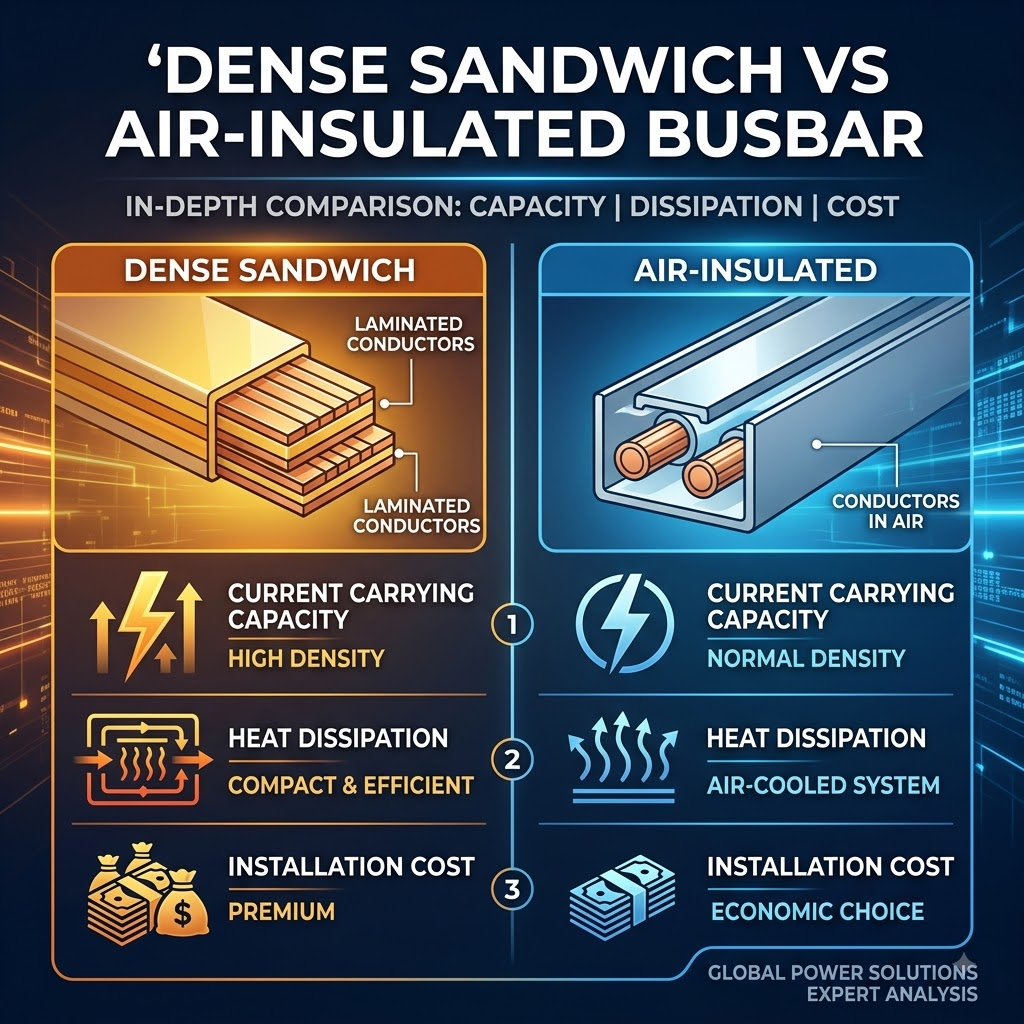
Table of Contents
1. Introduction to Mainstream Low-Voltage Busbar Systems
2. Structural Differences Between Sandwich-Type and Air-Insulated Busbars
3. Busbar Current Carrying Capacity Performance Analysis
4. Busbar Heat Dissipation Mechanism and Temperature Rise Test Data
5. Installation and Lifecycle Cost Comparison
6. Authoritative Industry Performance Data Table
7. Professional Industry FAQs
1. Introduction to Mainstream Low-Voltage Busbar Systems
Dense busbar, also widely known as sandwich-type busbar, dominates modern high-current power distribution projects.
Air-insulated busbar remains a traditional solution for low-load and cost-sensitive scenarios.
The selection of busbar systems mainly depends on three core indicators: busbar current carrying capacity, busbar heat dissipation efficiency and overall installation cost.
Many engineering designers confuse the application boundaries of these two structures, leading to insufficient power capacity or wasted budget.
Based on IEC 61439-6 international standards, this article conducts a full-dimensional professional comparison.
2. Structural Differences Between Sandwich-Type and Air-Insulated Busbars
2.1 Dense Sandwich Busbar Structure
Sandwich-type busbar adopts a compact laminated design. Conductors are tightly stacked with insulating materials without air gaps.
The overall structure is integrated and ultra-thin, with the metal shell closely fitting the internal insulation layer.
This compact layout greatly optimizes internal heat conduction and current uniformity.
2.2 Air-Insulated Busbar Structure
Air-insulated busbar relies on natural air gaps between conductors for insulation and heat dissipation.
It requires larger internal space, resulting in a bulky overall box size.
The structural design is simple, but it limits high-current operation and long-term stable heat dissipation.
3. Busbar Current Carrying Capacity Performance Analysis
3.1 High-Current Operation Advantages of Dense Busbars
Busbar current carrying capacity is restricted by conductor impedance and heat accumulation.
The dense laminated structure reduces reactance and current deviation significantly.
It can stably support ultra-high current transmission up to 6300A, suitable for data centers and industrial workshops.
3.2 Limitations of Air-Insulated Busbars
Air insulation causes unbalanced current distribution and large eddy current loss.
Its stable current is usually limited below 1000A, unable to adapt to high-load power distribution.
Under the same conductor cross-section, dense busbars have nearly 30% higher effective current carrying efficiency.
4. Busbar Heat Dissipation Mechanism and Temperature Rise Test Data
4.1 Heat Conduction Principle of Dense Busbar
Excellent busbar heat dissipation is the core advantage of dense busbar.
It adopts contact heat conduction. Internal heat is quickly transferred to the outer metal shell for rapid dissipation.
No concentrated heat accumulation occurs during long-term high-load operation.
4.2 Heat Dissipation Defects of Air-Insulated Busbar
Air convection heat dissipation is slow and unstable, easily affected by ambient temperature.
Under continuous rated current, the internal temperature rise is obviously higher than dense structures.
Long-term high temperature accelerates insulation aging and reduces system service life.
5. Installation and Lifecycle Cost Comparison
Air-insulated busbars have lower upfront material costs and simple installation processes.
But it requires more installation space and regular maintenance due to heat aging risks.
Sandwich-type busbar has higher initial investment but extremely low failure rate and maintenance cost.
Its compact structure saves vertical shaft space, bringing long-term engineering value.
6. Authoritative Industry Performance Data Table
The following test data strictly follows IEC 61439-6 standards, intuitively showing the performance gap between the two busbar types.
Performance Index | Dense Sandwich Busbar | Air-Insulated Busbar | Test Condition |
Max Stable Current | 6300A | ≤1000A | 25℃ Ambient Temperature |
8h Continuous Operation Temp Rise | ≤55K | ≤70K | 1.1x Rated Current |
Relative Current Carrying Efficiency | 130% | 100% | Same Conductor Section |
Lifecycle Maintenance Cost | Low | Medium-High | 20-Year Operation Cycle |
Data proves that dense busbar fully outperforms air-insulated products in current carrying and heat dissipation.
Air-insulated busbars only have cost advantages in low-current and short-cycle projects.
7. Professional Industry FAQs
Q1: What is the core difference between sandwich busbar and air-insulated busbar?
A1: The core difference lies in insulation and heat dissipation structure. Sandwich-type busbar uses compact laminated structure with conduction heat dissipation, while air-insulated busbar relies on air gap convection, resulting in lower busbar current carrying capacity.
Q2: Which busbar is suitable for data center and factory high-current projects?
A2: Large-scale power distribution scenarios must adopt dense busbar. Its strong busbar heat dissipation performance and high current carrying capacity ensure long-term stable operation of high-load equipment.
Q3: Why dense busbar has higher current carrying efficiency with same conductor size?
A3: The dense laminated structure reduces internal reactance and eddy current loss. Uniform heat conduction avoids local overheating, so it can carry larger safe current than air-insulated structures.
Q4: Is air-insulated busbar completely eliminated in modern engineering?
A4: No. It is still cost-effective for small buildings, low-current distribution and short-term temporary projects, with simple installation and low upfront cost.